Massage for Sciatica Relief in Boulder City, NV
If you have ever felt a sharp, electric line of pain travel from your low back through your buttock and down the back of your leg, you already know why sciatica is one of the most disruptive kinds of pain there is. It makes sitting uncomfortable, standing tiring, and sleeping frustrating. It follows you into the car, into your work chair, and into bed.
One of the most common questions I hear at Desert Bloom Massage is whether massage can help. The honest answer is yes, often meaningfully -- but it depends a great deal on what is causing the sciatica in the first place. Here is a straightforward look at what massage can do, what it cannot do, and how to know which situation you are in.
First, sciatica is a symptom, not a diagnosis
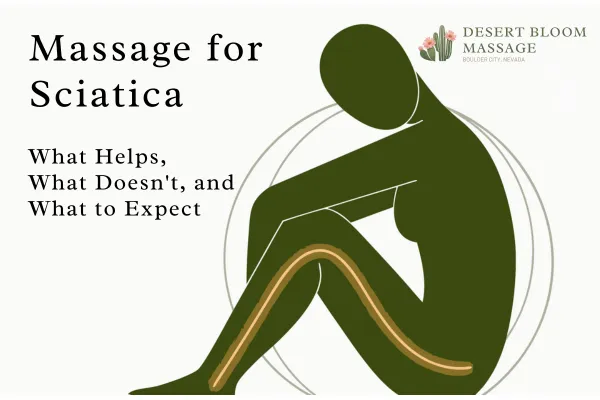
"Sciatica" simply describes pain that follows the path of the sciatic nerve, the largest nerve in the body. It runs from the lower spine through the buttock and down each leg. When something irritates or compresses that nerve, the pain shows up along its route.
Several very different problems can produce that same pattern:
Herniated or bulging disc-- disc material presses on a nerve root as it exits the spine
Spinal stenosis-- narrowing of the spinal canal crowds the nerve
Piriformis syndrome-- a tight, overworked muscle deep in the buttock compresses the nerve as it passes underneath
Degenerative disc changes-- age-related narrowing that reduces the space nerves travel through
Pelvic or postural imbalance-- chronically shortened hip and low-back muscles pulling everything out of alignment
That distinction matters, because massage addresses the muscular contributors extremely well and the structural ones only indirectly.
What massage actually does for sciatic pain
Releases the muscles that compress the nerve
This is where massage does its most direct work. The piriformis, gluteus medius and minimus, deep hip rotators, and the quadratus lumborum in the low back all sit along or near the sciatic nerve's path. When these muscles are chronically tight, they can squeeze the nerve directly or pull the pelvis into a position that irritates it. Skilled, sustained work on these areas can reduce that mechanical pressure. For piriformis-driven sciatica in particular, the relief can be dramatic.
Reduces the protective guarding around the injury
Pain makes muscles brace. That bracing then restricts movement, which creates more pain, which produces more bracing. Massage interrupts that cycle. Even when the underlying cause is a disc issue that massage cannot resolve, easing the secondary muscle guarding often takes a significant portion of the daily discomfort off the table.
Improves circulation to irritated tissue
Increased blood flow to the low back, hip, and glute region brings oxygen and nutrients in and helps move inflammatory byproducts out. Tissue that is well-perfused simply tolerates load better than tissue that is tight and starved.
Calms an over-sensitized nervous system
This one gets overlooked, and it may be the most important. Persistent pain trains the nervous system to amplify signals. Sustained, unhurried massage shifts the body toward a parasympathetic state, which measurably lowers pain sensitivity. Clients frequently report that the pain is still technically there after a session but that it no longer feels as loud or as threatening.
Restores mobility you have been avoiding
Most people with sciatica have stopped moving in certain directions without realizing it. As hip and low-back tissue lengthens, that guarded range of motion tends to come back, and normal movement is one of the better long-term treatments for nerve irritation.
What massage will not do
I would rather set an accurate expectation than oversell a session.
Massage cannot reposition a herniated disc, widen a narrowed spinal canal, or reverse degenerative changes in the spine. If your sciatica is driven primarily by a structural issue, massage becomes a supportive therapy that manages symptoms and improves function -- valuable, but working alongside medical care, not instead of it.
Massage is also not a single-session fix for a problem that took months or years to develop. Chronic sciatica generally responds to a series of sessions with meaningful work between them, not one appointment.
What a sciatica-focused session looks like at Desert Bloom
Every session begins with a conversation. I want to know where the pain starts, how far down the leg it travels, what makes it worse, what gives you relief, how long it has been going on, and what your doctor or chiropractor has told you. That history shapes everything that follows.
From there, the work typically involves:
Broad warming work through the low back, hips, and glutes before any deeper pressure
Targeted release of the piriformis and deep hip rotators
Attention to the quadratus lumborum and lumbar paraspinals, which almost always contribute
Work on the hamstrings, which frequently tighten in response to sciatic irritation
Hip flexor and psoas attention, since the front of the hip pulls on the low back more than most people expect
Gentle stretching and range-of-motion work near the end of the session
Pressure is adjusted continuously. Deep work has its place with sciatica, but aggressive pressure over an already-irritated nerve can make symptoms worse for days. After 17 years of practice, I have learned that the right pressure is the pressure your tissue actually accepts, not the pressure that sounds impressive.
Session length matters here
For sciatica, I generally suggest at least 60 minutes, and 90 minutes if the pattern is long-standing. There is a lot of territory to cover between the low back, both hips, the glutes, and the hamstrings, and rushing that region tends to produce a session that feels busy rather than effective.
The chiropractic connection
Desert Bloom Massage is located inside Total Health Chiropractic in Boulder City, and for sciatica clients that arrangement is genuinely useful. Chiropractic care addresses joint mechanics and alignment; massage addresses the soft tissue that moves and stabilizes those joints. When muscles around the pelvis and low back are chronically tight, adjustments have a harder time holding. When those muscles release, adjustments tend to hold longer and feel better.
If you are already under chiropractic or physical therapy care, tell me. I will work with what your provider is doing rather than around it.
What helps between sessions
The work you do at home matters as much as the hour on the table:
Change positions often. Prolonged sitting is one of the strongest aggravators of sciatic pain. Stand and walk briefly every 30 to 45 minutes.
Get your wallet out of your back pocket. It sounds trivial. It is not. Sitting on a wallet compresses the piriformis region for hours a day.
Walk. Gentle, regular walking usually helps more than rest.
Use heat before activity, cold after flare-ups. Heat loosens guarded muscle; cold calms acute irritation.
Stretch gently and consistently. Figure-four glute stretches and easy hamstring work, held comfortably rather than forced.
Stay hydrated. Especially here in the Southern Nevada climate, where dehydration sneaks up on everyone.
When to see a doctor first
Please seek medical evaluation before booking a massage if you are experiencing any of the following:
Loss of bladder or bowel control
Numbness in the inner thighs or groin area
Progressive weakness in the leg or foot, or difficulty lifting the foot
Sciatic pain following a fall, car accident, or other trauma
Pain accompanied by fever or unexplained weight loss
These can indicate conditions that require prompt medical attention. Massage is not the right first step in those cases.
The realistic bottom line
For sciatica driven by muscular tension and postural patterns, massage can be remarkably effective. For sciatica driven by structural changes in the spine, massage is a valuable part of a broader care plan that keeps you more comfortable and more mobile while other treatment does its work.
Either way, you do not have to simply live with it. If you have been managing sciatic pain in Boulder City and want to talk through whether massage is a good fit for your situation, I am glad to have that conversation honestly, including telling you if I think another provider should see you first.
Book your session
Sessions from 30 to 180 minutes are available Monday through Friday, 7:00 AM to 7:00 PM, and Saturday mornings, 7:00 AM to 12:00 PM.
Book Online here: desertbloommassage.com
Call: (702) 760-7656
Location:1637 Boulder City Pkwy STE B, Boulder City, NV 89005 (inside Total Health Chiropractic, Red Mountain Plaza)
Sarah Lopez is a Nevada-licensed massage therapist (License #12962) and AMTA member with 17 years of therapeutic practice.
This article is provided for general education and is not medical advice. Massage therapy complements medical care; it does not replace it. Consult a qualified healthcare provider regarding persistent, severe, or worsening sciatic pain.